|
1448, Sir Alexander Montgomery, Sir
Robert Cunninghams' brother-in-law, was
made Bailie of Cunninghame, a title that
belonged to Sir Robert Cunningham. This
event sparked the bloody
Montgomery/Cunningham feud that lasted
until the 1660s.
1458, Sir Alexander Cunningham was
rewarded for his support of King James II
(Stuart) against the Clan Douglas. He was
granted the Barony of Kilmaurs, along
with the lands of Kilmarnock, Hilton,
Finlaystone and Glencairn.
1488, Sir Alexander Cunningham is made
1st Earl of Glencairn by royal charter,
and receives Drummond and Duchray in
Lennox for helping defeat the rebels at
Blackness (the rebels being an army of
King James III son James fighting to
overthrow his father).
June 1488, Sir Alexander Cunningham
and King James III were killed at the
Battle of Sauchieburn. The victorious son
became King James IV of Scotland.
Later in 1488, King James IV revoked
all titles given by his father over the
past few years. Sir Alexander
Cunningham's son and heir, Robert
Cunningham, lost his title of 2nd Earl of
Glencairn. He did retain the earlier
title of 2nd Lord Kilmaurs.
Also in 1488, the Montgomerys' burned
the Cunninghams' Kerelaw Castle.
1499, Cuthbert Cunningham, 3rd Lord
Kilmaurs, lead the Clan in an attack on
Montgomerys' at Irvine.
1528, William Cunningham, 4th Earl of
Glencairn, lead an attack on the
Montgomerys' and burned their Eglinton
Castle at Irvine in Ayrshire.
The fifth Earl of Glencairn, a
Protestant reformer, fought against Mary
Queen of Scots forces. He was one of the
commanders at the Battle of Carbery Hill
where she surrendered in 1567. Glencairn
is said to have ordered the destruction
of the Chapel Royal at
Hollyrood/Edinburgh.
1586, the Cunningham-Montgomery feud
erupts after Hugh Montgomery, 4th Earl of
Eglinton, is murdered by Cunninghams'.
James Cunningham, 7th Earl of Glencairn
and 7th Lord Kilmaurs is head of the clan
at that time.
1661, William Cunningham, 9th Earl of
Glencairn, is made Lord High Chancellor
of Scotland for life. His marriage to
Margaret Montgomery, daughter of
Alexander, 6th Earl of Eglinton, ended
the Cunningham-Montgomery feud.
The Cunningham’s were among the
Scottish involved in the Plantation of
Ulster. Sir James Cunningham, who was
married to a daughter of the Earl of
Glencairn, was granted five thousand
acres in County Donegal. The name is now
among the seventy-five most common names
in Ulster.
The 9th Earl of Glencairn raised an
army in Scotland to fight for Charles II
in his bid to gain his father’s
throne. Somehow he managed to avoid
execution by Cromwell after the uprising
was crushed.
1699, Sir John Cunningham of
Caprington, a distinguished lawyer, was
created a Baronet of Nova Scotia by
Charles II.
Other prominent Cunningham’s
were Alexander Cunningham, an
eighteenth-century historical writer, who
was British envoy to Venice from 1715 to
1720.
Charles Cunningham was famous for his
historical paintings, some of which still
hang in the Hermitage Palace in St
Petersburg and Berlin.
Alan Cunningham, poet and writer, whom
many believe was only eclipsed by Robert
Burns, was born at Blackwood in
Dumfriesshire in 1784. His work was
supported by Sir Walter Scott who, on
Cunningham’s death in 1828,
provided for his two sons.
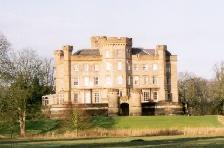
Caprington Castle was remodelled in
the 1780s, and again in the 1830s. The
castle still remains in the Cunningham
family to this day.
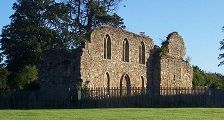
The ruin of Kerlaw Castle has been
preserved as a tourist attraction.
The Cunninghams' were known for their
local fueds with other Ayrshire Clans
such as the Montgomerys'.
The Cunninghams' were connected to
other Ayrshire Clans through marriage
such as the Cambells' and Hamiltons'.
|