|
Kilmarnock is the
largest Town in Ayrshire southwest
Scotland, seven miles inland from
the coast with good shopping,
restaurants, bar diners, leisure
facilities and historic
attractions.
The success of Robert the Bruce
and his loyal supporters at the
Battle of Bannockburn in 1314, saw
the lands of Kilmarnock awarded to
his most faithful Clans.
The Boyd’s built Dean
Castle to the north of Kilmarnock,
Craufurd’s built Craufurdland
Castle to the northeast,
Cunningham’s built castles to
the north at Kilmaurs and south at
Caprington, and the Mure’s
built Rowallan Castle to the north.
Castle Estates at that time allowed
the Town to grow rapidly, as they
employed many workers to cultivate
the land for growing crops,
vegetables, and fruit, also for
mining and timber.
Kilmarnock became known for
Scottish Bonnet Making from 1647,
and later for Carpet Manufacturing,
some of which were laid in the
finest homes throughout the world.
The Town was created a Royal Burgh
by Charles II in 1672.
One of the world's most famous
Whisky producers was born in
Kilmarnock in 1805, named John
Walker.
54
Large Images . Whats
On
HD
Video / Slide
|
|
|
King
Street
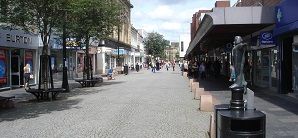
is Kilmarnock’s main
shopping area, a pedestrian only
street that leads to Kilmarnock
Cross.
|
|
|
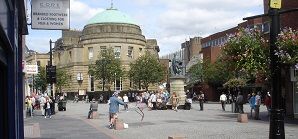
Kilmarnock
Cross
or Forgate Square, with a statue
of Robert Burns, is at the centre
of Kilmarnock’s shopping
area.
|
|
|
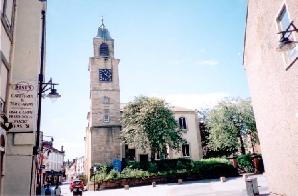
Laigh West
High Kirk
is to the left / west of the
Square on Sandbed Street, with
this being the most prominent
building, built in 1802 to
replace an earlier Church.
|
|
|
You can find a life size Statue of
Johnnie Walker at this Church. Johnnie
Walker built one of the top Scottish
whisky blending warehouses at
Kilmarnock.
Johnnie Walker Statue Large
Image
There are at least eight Churches
around the centre of Kilmarnock, varying
in age and architecture.
|
|
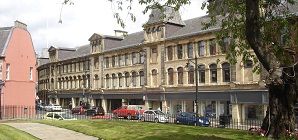
Johnnie
Walker Bond
building
is across the road from the Laigh
West High Kirk, on Strand
Street.
|
|
|
This was the old Johnnie Walker whisky
warehouse. The first part of the building
was built in the French Renaissance style
in 1895, with later extensions added in
1898 and 1907.
The building now holds the local
Council's Planning, Social Work, and
Roads Departments. The Windows have Large
Images of the Warehouse when it was in
production, and information on the
building. Large
Image
Walker built up an Italian warehouse,
grocery, and wine and spirits shop on the
High Street in Kilmarnock, where he sold
his own brand of whiskey, named Walker's
Kilmarnock Whisky. His son, Alexander
Walker, was credited with blending their
Old Highland Whisky in about 1867, that
was re-named Johnnie Walker Black Label
in 1909, one of the most famous brands of
whisky around the world to this day.
The Johnnie Walker whisky was made
around Scotland, at various distilleries,
then taken to Kilmarnock to be
blended.
The last Johnnie Walker plant in
Kilmarnock closed in 2012. Their whisky
is now blended in Levin, Fife, and
Glasgow.
For more information on Johnnie
Walker, and other wealthy Kilmarnock
businessmen, and their grand houses, you
have to visit the Dick Institute
Museum.
|
|
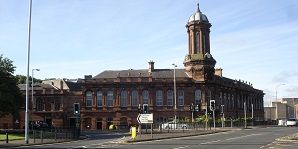
Palace
Theatre
in Kilmarnock is at the corner of
London Road, and Sturrock Street,
a short distance east of
Kilmarnock Cross.
|
|
|
The Theatre was completed in 1862.
Large
Image . Website
Theatrical entertainment at the
Theatre consists of classics,
children’s shows, and contemporary
and classical music. Tel: 01563 554
900.
Events
Website . Map/Reviews
|
|
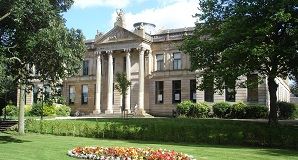
Dick
Institute
is on Elmbank Avenue, just off
London Road, a short walk from
the town centre, a few hundred
yards past the Palace Theatre.
Website
|
|
|
This Museum and Art Gallery, that
opened in April 1901, host’s
collections showing local industrial,
social, and natural history.
Here you can find information on
Johnnie Walker, John Wilson the Robert
Burns printer, and other wealthy
businessmen from the area, and their
grand houses. The Institute is open Mon,
Tue, Thur, and Friday 09.00 - 20.00, Wed
and Sat 09.00 - 17.00. Tel: 01563 554
300.
Map/Reviews . Large
Image
|
|
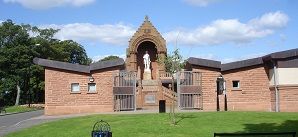
Kay
Park
is a short walk north of the Dick
Institute, up Holehouse Road,
past Kilmarnock College.
|
|
|
The Park contains a large pond with
swans and ducks, large outdoor children's
play area, and vast parkland.
Website . Map/Reviews
Kay Park also holds the Burns Monument
Centre, with a large Monument to the poet
Robert Burns.
The Centre also contains Family
Research facilities, and Archives for
Family and Local History. The Centre can
be hired for weddings, and is used for
the registration of births, deaths, and
marriages.
Robert Burns most famous work (The
Kilmarnock Edition) was Published in
Kilmarnock by printer John Wilson in
1786. The Burns Monument Centre houses a
3 dimensional digitised representation of
the Kilmarnock Edition, also with a
selection of poems sung and narrated.
Tel: 01563 553 654.
Large
Image . Large Image across Kay
Park
|
|
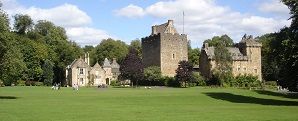
Dean
Castle
is on the north side of
Kilmarnock off Dean Road.
|
|
|
Dean Castle was built from the 1300s
for the Boyd’s (Earls of
Kilmarnock).
Website .
AS Photo Page
Howard de Walden, the last owner,
gifted Dean Castle and estate to the
people of Kilmarnock in 1975.
The Estate is now run as a Country
Park, free to visit, with a Visitor
Centre with a cafe, children's play area,
many walk/cycle routes, pony trekking,
tower museum, and Free Tours of the
Castle. Tel: 01563 554 734.
Large Image
from a woodland walk
Map/Reviews
|
|
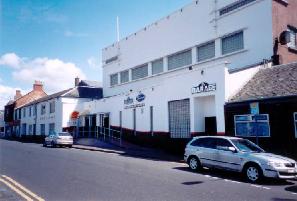
The
Garage
is on Grange Street, close to the
Town centre.
|
|
|
The Garage hosts go carts, ten pin
bowling, soft play area, Wimpy, bar &
function suite, amusements, kids parties
suite, and night club.
The ten-pin bowling is downstairs,
just inside the entrance.
The powerful go-karts are upstairs,
with a fair sized winding circuit. For
enquires or bookings phone 01563 573
355.
Website .
Map/Reviews
|
|
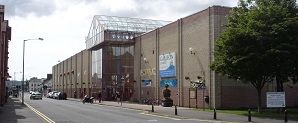
The Galleon
Centre
is on Titchfield Street, a few
hundred yards south of King
Street (the town centre).
|
|
|
This Centre contains a swimming pool,
ice rink, bowling hall, 2 sports halls,
squash courts, sauna/solarium suite,
fitness room, and two bars, one of which
overlooks the ice rink. Tel: 01563 524
014.
Website for the Galleon, giving a full
list of fees for each activity is
Website .
Map/Reviews
|
|
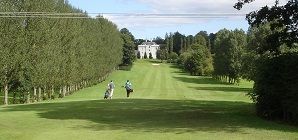
Annanhill
Golf Club
is a 6,000 yard par 69 on the
west side of Kilmarnock, off
Irvine Road.
|
|
|
This is a fine looking course with
many fairways being lined with trees.
Price about £22 per round. Tel:
01563 521 512.
Website .
Map /
Reviews
On the south side of Kilmarnock is the
Gaprington Golf Course, another fine
tree-lined course, also inexpensive for
visitors to play. Tel: 01563 521 915.
Website . Map /
Reviews
On the north side of Kilmarnock is the
opened in 2010, championship standard
Rowallan Castle Golf Club. Price about
£50 per round. Tel: 01563 530
550.
Website . Map /
Reviews
All Ayrshire golf
courses
|
|
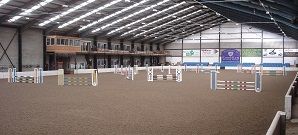
Morris
Equestrian Centre
is 3 miles north of Kilmarnock
centre with large riding arenas
that host regular show jumping
events.
|
|
|
|
|