Tour of Paris |
|
The Eiffel Tower is situated in the centre of Paris. Most of the tourist attractions are situated within walking distance of the tower. Also, many of the large river boats depart from close to the tower. The Eiffel Tower was built for the International Exhibition of Paris of 1889 commemorating the centenary of the French Revolution. At 300 metres and 7000 tons, it was the world's tallest building until 1930. Price for the lifts to the top is about €11 per adult €6 per child. |
 |
|
The Arc de Triomphe was commissioned by Napoleon in 1806 shortly after his victory at Austerlitz, it was not completed until 1836. Engraved around the top of the Arch are the names of major victories won during the Revolutionary and Napoleonic periods. The names of less important victories, as well as those of 558 generals, can be found on the inside walls. Generals whose names are underlined died in action. Beneath the Arch is the Tomb of the Unknown Soldier, and eternal flame commemorating the dead of the two world wars. There is a small museum inside the arch documenting its history and construction. Situated in Paris centre on the bus route. |

Louis XIV founded Les Invalides in 1670 near what was then called the Grenelle Plain (an old soldiers home). The dome was constructed between 1706 and 1708. The most significant event in the history of Les Invalides was the return of the body of Napoleon in 1840. After seven years of negotiation with the British government, Louis-Philippe, King of France, obtained permission to repatriate Emperor Napoleon's remains from St. Helena. On October 8th, 1840, 19 years after the death of the Emperor, the coffin was exhumed then transported to France aboard the frigate La Belle Poule. On April 3rd 1861, Napoleon I was laid to rest in the crypt under the dome. Situated close to the Eiffel Tower on the bus route. Open 10.00 - 21.00, price per adult about €8, children free. |
 |
|
Construction of Notre-Dame de Paris began in 1163 during the reign of Louis VII. Construction was completed roughly 200 years later in about 1345. The choir was completed in 1182; the nave in 1208, and the west front and towers between 1225 and1250. At the end of the 18th century, during the Revolution, many of the treasures of the cathedral were either destroyed or plundered. Only the great bells avoided being melted down. After falling into disrepair, a restoration program was carried out in 1845. This program that lasted 23 years included the construction of the spire. Mary Stuart was crowned Queen of France here after her marriage to François II. Situated in the centre of paris on the bus route. Free entry when there are no services in progress. |

The Opera was built between 1862-1875 with the architect being Charles Garnier. This is probably the most ornate building in Paris attracting a lot of interest from tourists. Situated in the centre of Paris on the bus route. Open for tours 10.00 - 16.30. price €5 ?. |
 |
|
The Basilique du Sacr'e-Cceur was built after the Franco-Prussian War of 1870. Plans for the new basilica were to incorporate the Romano-Byzantine style. The first stone was laid in 1875 with the building completed in 1914. The interior of the church contains one of the worlds largest mosaics depicting Christ with outstretched arms. The nearby bell tower contains the Savoyarde. Cast in Annecy in 1895, it is one of the worlds heaviest bells at 19 tons. Situated west of Paris centre not on the bus route. Can be seen from the Eiffel Tower. The Basilique and Crypt are open 09.00 - 20.00, entrance fee about €25. |

The origins of the Louvre Palace date to 1200 when Philippe August began construction of a fortress on the banks of the Seine. It first became the official royal residence under Charles V who also constructed a new perimeter with a moat (part of the moat still exists today). The Palace was extended by kings and emperors over the centuries into the vast building that can be seen today. After France became a Republic, the Louvre was converted to a museum housing statues and paintings from around the world, including the Mona Lisa. In 1981, Ieoh Ming Pei was commissioned to create a new reception area with modernized entrance to the Museum. The Pyramid that is now the entrance officially opened in April 1989. There have been heated debates ever since as to whether the pyramid design should have been chosen as an entrance this historic building. Situated in Paris centre on the bus route. Open 09.00 - 18.00 each day with an entrance fee of about €9. |
 |
|
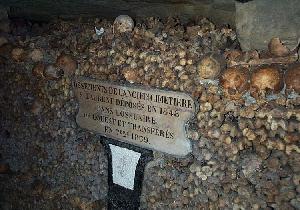
The Catacombs of Paris were originally depleted limestone quarries, some from the Roman times. Burials in the Catacombs began in 1786 as the Les Halles district was suffering from contamination caused by poor burials and mass graves in the churchyard cemeteries. The authorities decided to discreetly move the bones to the underground passageways. During World War II, some Parisian cells of French Resistance used the tunnel system. The Germans also established an underground bunker for their own use. This bunker can be reached only by "unofficial" visits. The only official way to visit is through the Catacomb Museum in the Montparnasse Quarter at : 1, place Denfert-Rochereau. Tel: +33 01 43 22 47 63. |
|
For a full list of museums and monuments in Paris view the website www.paris.org/Maps/MM/.You can click on the map to get details of each venue. |
|
Late Rooms is an excellent website for booking Hotels in Paris. Simply click on the banner below. You will then see a selection of hotels with prices for the next few days. To view dates up to three months in advance, choose the arrival date and how many nights you plan to stay in the Search Engine then click Go. You will then see a list of hotels with prices and available rooms on those dates. Rooms can then be booked using the secure online booking system. |
 |
|
Car hire from Prestwick, Glasgow or any other European Airports can be found at: www.arguscarhire.com. Argus Car Hire offer low cost car hire at Glasgow Prestwick Airport in Scotland with the best fully inclusive car hire rates from the world's top 100 car rental companies. Argus Car Hire provide a wide choice of vehicles from budget economy options through to luxury autos. Argus will compare all the top car hire providers based at Prestwick Airport, or any other European Airport, to find you the very best deals available.
|
